Graphic Design Outsourcing
Graphic Design Outsourcing: The Honest Guide Nobody Else Will Write...
Graphic Design Outsourcing: The Honest Guide Nobody Else Will Write
Here's something that'll make you rethink everything about outsourcing design work: graphic design just became the 11th fastest-declining job category according to the World Economic Forum's 2025 report. Two years ago, it was listed as "moderately growing." What changed? AI didn't just disrupt the industry—it's systematically replacing the entry-level work most businesses think they're outsourcing. I'm Stephen Atcheler, and I've spent 15 years watching businesses in the USA, Australia, and New Zealand make expensive mistakes with offshore staffing. This article isn't going to sell you on graphic design outsourcing. In fact, if your business is doing under $500,000 in annual revenue, I'm going to tell you exactly why you shouldn't do it. But if you're ready for the truth about what outsourcing actually costs, when it works, and what AI has already replaced, keep reading. Fair warning: Google Trends shows bugger-all search volume for "graphic design outsourcing" in any of our markets. That tells me most businesses don't even know they're asking the wrong question. They search for "hire graphic designer" or "freelance designer" and end up drowning in subscription service promises of "unlimited designs" that aren't remotely unlimited. This guide exists to help you figure out IF you should outsource before anyone tries to sell you on HOW.
The $500,000 Revenue Threshold Nobody Mentions
Every graphic design platform will tell you their service is perfect for "businesses of all sizes." Complete rubbish. Here's the reality: if you're doing under $500K annual revenue, outsourcing design will likely cost you more than it saves—especially in your first year. The maths is brutal. That "$25/hour Philippines designer" everyone advertises? Let's calculate what you're actually paying: Designer cost: $25/hour × 20 hours/week × 52 weeks = $26,000 Software access: (Figma, Dropbox, brand assets) = $1,200/year Your management time: 4 hours/week × 52 × $100/hour = $20,800 Revisions in first 90 days: (They're learning your brand) = $5,000 Mistakes and rework: (Wrong fonts, off-brand designs) = $3,000 Total Year One: $56,000Effective hourly rate: $54/hour, not $25 A mid-level US designer costs around $58,000/year ($27.88/hour). Australian businesses pay $60,000-75,000 AUD for similar talent. New Zealand sits at $55,000-70,000 NZD. When you factor in management overhead, your year-one "savings" from outsourcing might be 10-15%, not the 70% those subscription services promise. The break-even point doesn't hit until month four or five, after your designer has learned your brand, understands your expectations, and stopped needing constant hand-holding. Most businesses quit during weeks 4-8—right in the frustration valley—and waste every dollar they invested.
When Outsourcing Design Is a Terrible Idea
Before we talk about when it works, let's discuss when it absolutely doesn't. I've watched these scenarios fail repeatedly across all three markets: You need strategic or brand-critical work. Brand identity, positioning, or anything requiring deep business understanding shouldn't be outsourced. Your offshore designer doesn't understand your market, your customers, or why your brand matters. They'll give you something that looks professional but feels generic because they're executing your brief, not thinking strategically. You're doing sporadic, one-off projects. If you need two designs this month and none next month, you're paying setup and onboarding costs every time. Use Canva Pro ($13/month) or project-based freelancers on Fiverr instead. The overhead of outsourcing requires consistent 20+ hours/week minimum to justify itself. You require real-time collaboration. Americans hiring from the Philippines face a 12-16 hour time difference. Your 9am is their 9pm. Urgent revision? It waits until tomorrow. That "quick fix" becomes a two-day turnaround. Australians actually have better time zone alignment with the Philippines (+2 to +4 hours), while New Zealand sits at +4 to +5 hours—still workable for same-day turnarounds. US businesses wanting real-time work should look at Latin America (Colombia, Mexico, Argentina) where time differences are 1-3 hours, not 12-16. You haven't documented your brand. If you don't have written brand guidelines, style examples, and clear processes, your outsourced designer will guess. And guess wrong. Repeatedly. You'll spend more time explaining what you want than it would take to do it yourself. You're looking for "cheap labour." If your primary motivation is finding the lowest possible rate, you're shopping for disaster. Quality designers—regardless of location—charge appropriate rates for their skill level. Rock-bottom prices attract rock-bottom work.
The AI Reality Everyone's Avoiding
Here's what subscription services and outsourcing platforms don't want you to know: your "professional designer" is already using AI tools extensively. Midjourney for image generation, Adobe Firefly for background removal, Canva AI for layout suggestions, ChatGPT for copywriting. The work you're outsourcing is increasingly AI-assisted, meaning you're paying human rates for partially automated output. This matters because AI has already replaced or automated the entry-level tasks most businesses think they're outsourcing: 90% AI-replaceable right now: Social media graphics, simple logo concepts, background removal, template customisation, colour palette generation 50% AI-assisted today: Website mockups, marketing materials, infographics, presentation decks Still requires human expertise: Brand strategy, custom illustration, complex packaging design, strategic creative direction The question isn't whether to outsource anymore—it's whether you need a human designer at all, or if you could use AI tools directly. For many businesses under that $500K threshold, subscribing to Midjourney ($30/month) and Canva Pro ($13/month) makes more financial sense than paying $1,500-2,000/month for a subscription service whose designers are using those same tools anyway.
What Actually Works: The Hybrid Approach
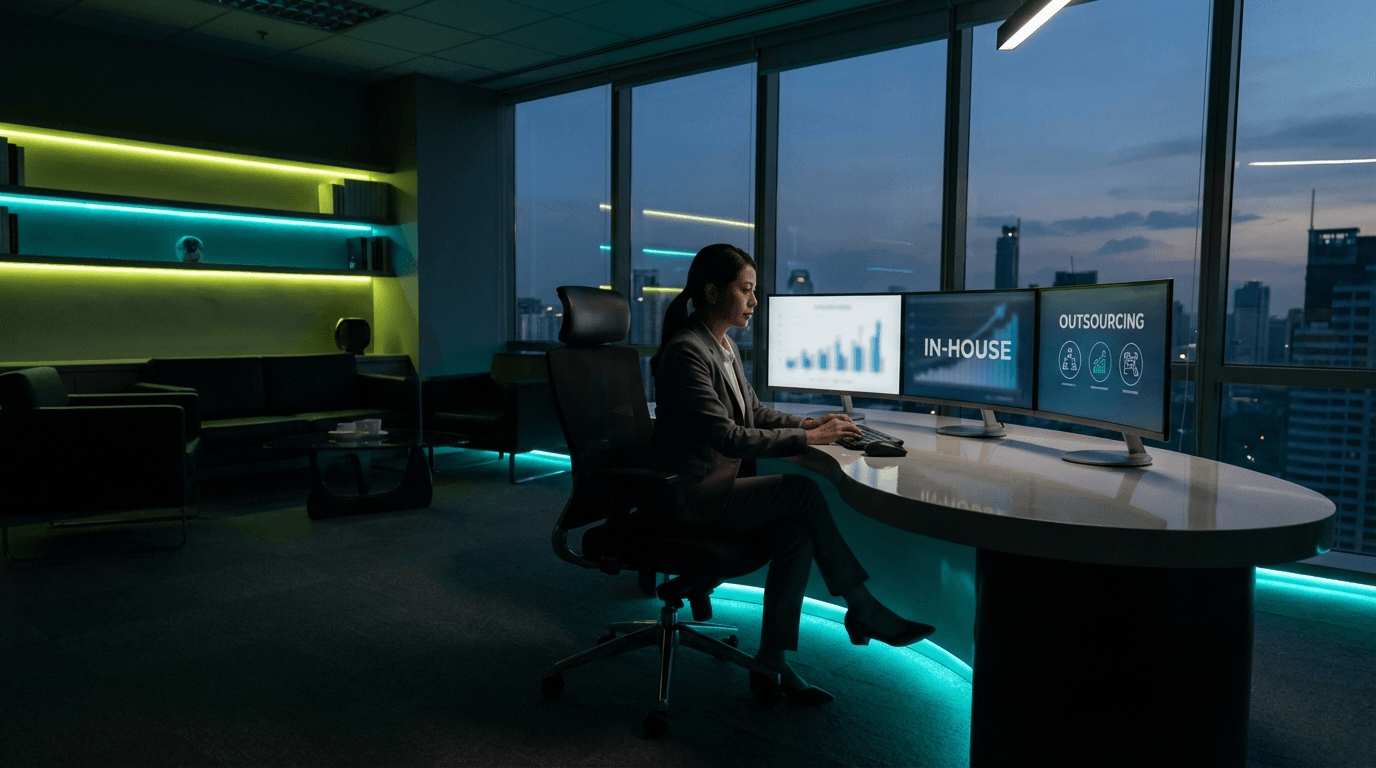
The smartest businesses I've worked with across the USA, Australia, and New Zealand don't choose between in-house, outsourced, or AI—they use all three strategically. In-house senior designer (part-time or full-time): Handles brand strategy, art direction, complex creative work, and quality control. This person sets the standards and makes strategic decisions. US businesses budget $50,000-70,000 for part-time or $70,000-90,000 full-time. Australian rates run $65,000-85,000 AUD, New Zealand $60,000-80,000 NZD. Offshore production team (Philippines or Latin America): Executes the templates, social graphics, marketing collateral, and repetitive work the senior designer has art-directed. At ShoreAgents, we place full-time Filipino designers for $1,200-2,500/month depending on experience level. Latin American designers cost slightly more but offer better time zone alignment for US businesses. AI tools for rapid iteration: Used directly by your in-house designer or offshore team for quick mockups, variations, and concept testing before committing to final designs. This hybrid model typically costs $90,000-120,000 USD annually but produces 3-4× the output of a single in-house designer while maintaining strategic oversight and brand consistency.
The First 90 Days: What Nobody Warns You About
Every outsourcing platform promises you'll "hit the ground running" and "see immediate results." In reality, outsourcing makes you slower before it makes you faster. Days 1-30: You're spending 10-15 hours creating brand guides, style examples, and process documentation. Your designer delivers 3-5 pieces, but 50-70% need major revisions because they're learning your brand. You think, "I could've done this faster myself." You're right. You could have. Days 30-60: Things improve slightly. You're down to 5-10 hours/week managing and giving feedback. Output increases to 8-10 deliverables, but revision rates are still 30-40%. You're not yet seeing ROI, but you're not losing as much productivity. Days 60-90: The turning point. Management time drops to 3-5 hours/week. Your designer is delivering 12-15 solid pieces monthly with only 15-20% needing revisions. You've broken even with what you could produce yourself. Month 4-6: Finally, the payoff. You're spending 2-3 hours/week managing and getting 15-20 high-quality deliverables. Your effective productivity has increased 25%, and the financial ROI is clear. Most businesses quit during weeks 4-8—right before it starts working. They've invested time and money into the learning curve, then bail before seeing returns. If you're not prepared to commit to at least 120 days, don't start.
Real Costs Across Markets
Let's talk actual numbers for USA, Australian, and New Zealand businesses, because the cost comparisons look different depending on where you're operating: In-House Designer (Full-Time):
- USA: $57,990/year salary + 20-30% benefits = $70,000-75,000 total
- Australia: $65,000 AUD salary + superannuation = $72,000-78,000 AUD total
- New Zealand: $60,000 NZD salary + KiwiSaver = $66,000-72,000 NZD total ShoreAgents Full-Time Offshore Designer:
- USA businesses: $1,200-2,500 USD/month ($14,400-30,000/year)
- Australian businesses: $1,800-3,750 AUD/month ($21,600-45,000/year)
- NZ businesses: $1,900-4,000 NZD/month ($22,800-48,000/year) Subscription Services:
- Budget tier (Kimp): $599-999 USD/month
- Mid-tier (Design Pickle, ManyPixels): $1,500-2,000 USD/month
- Premium tier (TodayMade): $4,999 USD/month The catch with subscription services? That "unlimited requests" promise means one active request at a time with 48-hour turnaround. Realistically, you're getting 10-12 deliverables monthly, making the effective cost $150-200 per design—not exactly the bargain they advertise.
What You Should Never Outsource
Even if you've got the budget, the volume, and the commitment, some design work should never be outsourced: Brand strategy and positioning work needs someone who deeply understands your business, market, and customers. Surface-level execution without strategic foundation creates pretty designs that don't convert. Complex UX work requires user research, testing, and rapid iteration. Remote designers working across time zones can't provide the real-time collaboration UX demands. High-stakes brand launches give you one chance to get it right. Generic work from someone who doesn't understand your market risks missing the mark entirely. Sensitive or confidential materials carry IP protection risks. Enforcing NDAs across international borders is complicated enough without adding the risk of unauthorised reuse. For these scenarios, work with premium agencies, specialised consultancies, or in-house teams who can provide the strategic depth and market understanding the work demands.
The Honest Path Forward
If you've read this far and you're still interested in outsourcing design work, here's how to actually make it work: Start with a test project. Don't commit to monthly retainers or long-term contracts until you've proven the relationship works with a single, well-defined project. Document everything upfront. Create brand guidelines, style examples, approval processes, and communication protocols before your designer starts. The time you invest here saves triple the time later. Set realistic expectations. Budget 5-10 hours/week management time initially, accept that first month will be slower than doing it yourself, and commit to at least 90 days before judging results. Use the right model for your needs. Freelancers for sporadic work, subscription services for high-volume simple work, direct offshore hires for full-time dedicated needs.
Who This Actually Works For
You're ready to outsource graphic design if you can honestly answer yes to these questions:
- Annual revenue above $500,000?
- Consistent 20+ hours/week design work?
- Documented brand guidelines and processes?
- Willing to invest 90 days in learning curve?
- Budget 5-10 hours/week management time initially?
- Work is production-focused, not strategic? If you've answered yes to all six, outsourcing can save you real money and expand your capacity significantly. If you answered no to any of them, you're not ready yet—and that's fine. Use AI tools and project-based freelancers until you reach the threshold where dedicated offshore staffing makes sense. At ShoreAgents, we only work with businesses who meet these criteria because we're not interested in setting you up to fail. We place full-time Filipino designers at $1,200-2,500/month, but only after helping you determine if outsourcing actually makes sense for your situation. Sometimes the honest answer is "not yet"—and we'll tell you that. The graphic design outsourcing market is flooded with promises of unlimited designs and massive savings. The reality is considerably more nuanced, and the math only works for businesses operating at specific revenue and volume thresholds. Know which side of that threshold you're on before you spend a dollar.