
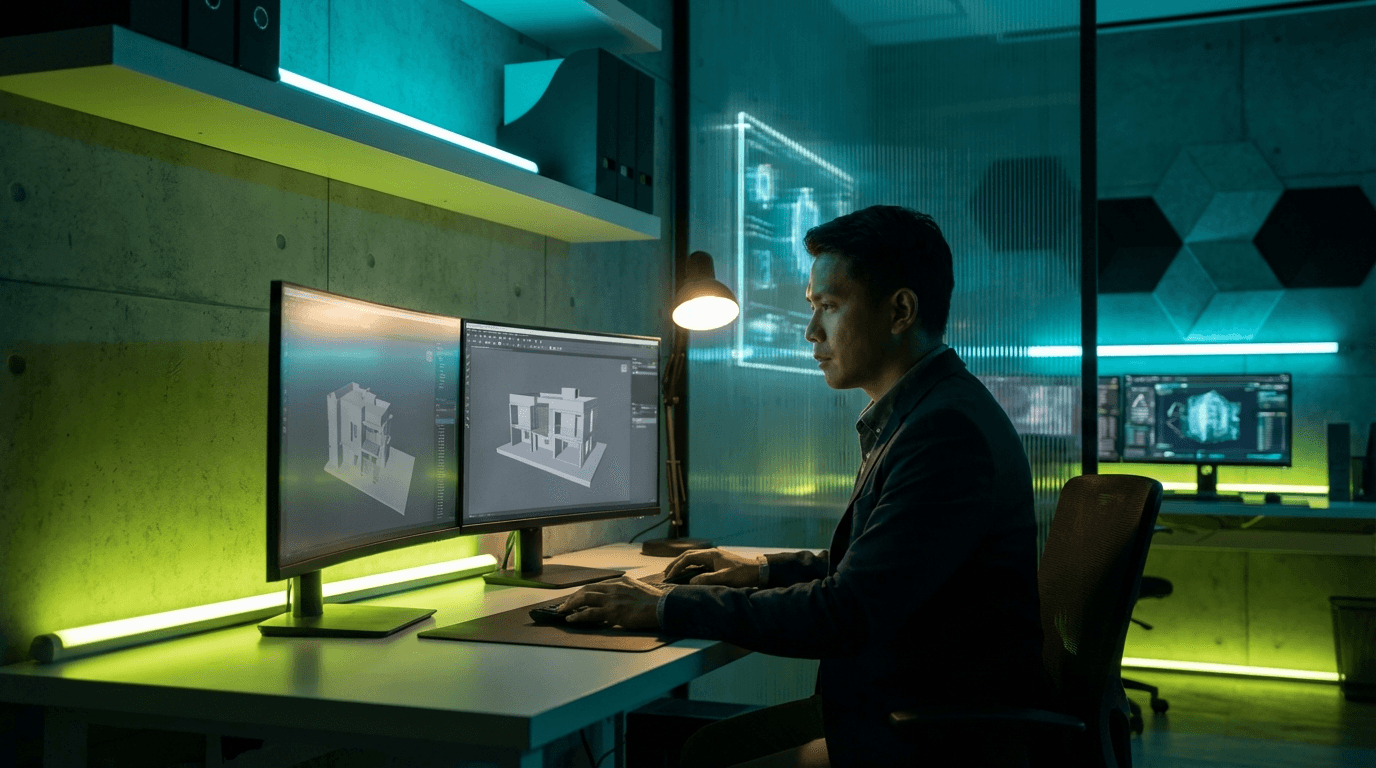

3D Visualization Virtual Assistant: Get Construction Right the First Time
Since 2019, I've hired 50+ 3D designers in Clark. Most come back. Why? Because a decent 3D vis VA catches design problems before they cost real money—missing structural details, clashes, client misunderstandings. One visualization saves 15–20 hours of email and rework. That's not leverage. That's just math.
What 3D Visualization Actually Does
3D visualization is CAD on steroids. You take architectural plans and turn them into something stakeholders can actually understand. Autodesk Revit, SketchUp, Blender, V-Ray—the tools are standard. What matters is the person using them can think like a designer and a builder at the same time.
The global architecture visualization market is growing, but that's not why you hire a VA. You hire one because:
- Your PM stops chasing details over email. The 3D model is the single source of truth. Clients see what they're getting.
- Design changes get caught early. Structural clashes, MEP conflicts, spatial problems—you spot them in 3D, not on the construction site at $500/hour penalties.
- Clients actually engage. A rendered walkthrough converts. A PDF doesn't.
- Bidders get clarity. Less scope creep. Less "wait, I didn't know the ceiling was that height."
- Presentations sell faster. Real visualization beats vague promises every time.
What a 3D Visualization VA Actually Does
Don't hire a designer if you just need someone to press buttons in Revit. You want someone who can:
- Build accurate 3D models from architectural drawings without turning them into art projects.
- Render realistic views—lighting, materials, textures—that look professional, not cartoonish.
- Create walkthroughs that let clients or investors see the space as if they're walking through it.
- Catch errors that architects miss or that come up during design coordination.
- Work cross-team. Talk to your architects, PMs, and clients. Understand what they actually need, not just what they asked for.
- Know their tools: Revit, SketchUp, Blender, V-Ray, Navisworks, AutoCAD. Proficiency matters.
How to Hire One
You need someone who can do both—technical accuracy and visual judgment. Here's how to find that:
- Write a real job spec. Don't ask for "3D visualization"—say what you actually need. Revit models? Walkthroughs? Client-facing renderings? Software clashes? Ask for exactly that.
- Portfolio tells you everything. Look at their work. Is it technically accurate or does it look like it was built in an afternoon? Can they make a building look good AND correct?
- Test them on a small project first. Give them a real design problem, pay them properly, see how they work. One small project costs $500–2,000. A bad hire costs way more.
- Check their communication. Can they explain what they're doing? Can they take feedback without defensiveness? A brilliant designer who can't talk to your PM is useless.
- Use ShoreAgents. We vet these people. You get someone who speaks English, works across your timezone, and won't ghost.
What It Costs
- Hourly rates: A solid Filipino 3D vis specialist runs $18–35/hour depending on experience. That's 1/3 the price of Australia, same technical bar.
- Project-based: Simple model, $500–2,000. Full walkthrough with rendering, $2,000–8,000. Client-facing photoreal package, $5,000–15,000. Depends on scope.
- Software: If they don't already own Revit/SketchUp, you may cover licenses. Blender and open-source tools are free.
One render that catches a structural issue before construction starts? That pays for three months of a VA right there.
Why the Philippines Works
I've hired across 13 countries since 2012. Philippines works for 3D visualization because:
- English is actually good. They can understand your briefs, ask smart questions, explain their work. No translation tax.
- Timezone overlap with Australia/NZ/Singapore. 8–10 hours of real working overlap. You can do quick feedback loops, same day turnarounds.
- Cost is half to a third of Western rates. Your $35/hour VA in Australia? Similar skill in Clark is $20–25/hour. Your $100/hour US designer? $25–30 in Manila.
- They actually stick around. ShoreAgents manages the boring bits—payroll, 13th month, NBI clearances, compliance. You focus on the work.
- Creative talent. Not as a buzzword. The Philippines has a legitimate design education pipeline and a lot of designers who've worked remotely for international teams.
Next Steps
If your construction projects are getting bogged down in design rework, emails about "what does this look like?", or scope creep from bad specifications, a 3D vis VA fixes that. They're not expensive. The ROI is clear.
Want to learn more about 3D rendering outsourcing, how to handle 3D modeling projects, or what a Navisworks specialist can actually do for you? Check those out. Or if you're ready to hire, start here: get started.
For more on virtual assistants, our pricing, or how outsourcing works at ShoreAgents, hit those links. Questions? Reach out.
Ready to Hire Your construction Assistant?
Get matched with pre-vetted construction VAs in 24 hours. Transparent pricing, no hidden fees.
Related Articles
GIS Virtual Assistant: Revolutionizing Construction Efficiency
Construction delays kill margins. GIS VAs catch data errors before they cost you weeks. Shore Agents places them from the Philippines at $20–30/hr. See why.
Drafting Outsourcing: Scale Your Construction Business with Virtual Assistants
Your CAD drafters cost $32/hour, not $15. We break down the hidden costs — software, training, management — that double offshore rates. Real pricing, no BS.
Architecture Admin Virtual Assistant: Streamline Your Construction Business
$2,250–$4,500 wasted weekly on admin work. Architects need a VA who gets Archicad, RFI, and construction timelines. Hire offshore from Shore Agents, Philippines.