
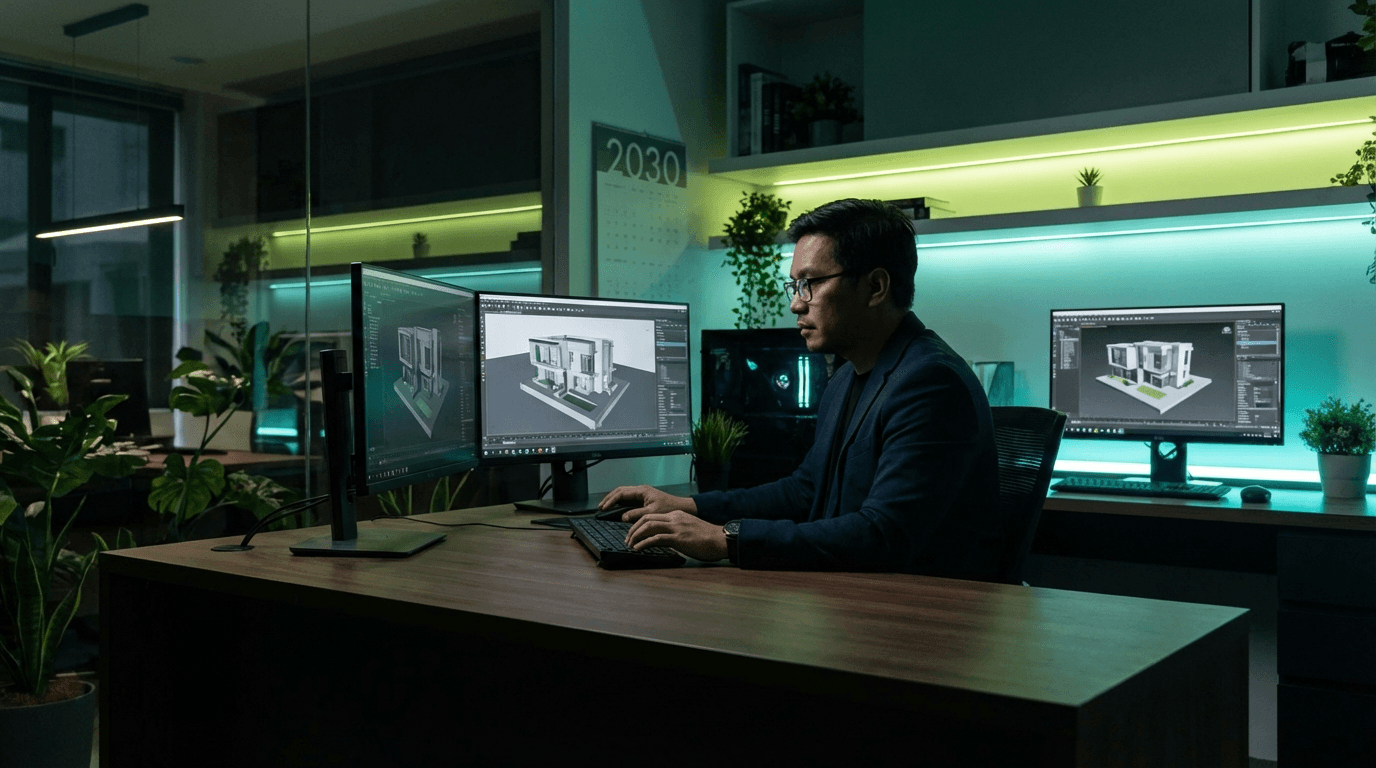

V-Ray Virtual Assistant: Optimize Your Construction Workflow
A Sydney architecture firm was burning 40 hours a week on V-Ray renders. Tight deadlines, in-house team stretched, every project a scope-creep nightmare. We placed one of our V-Ray VAs from Clark. Six weeks later: same output quality, half the timeline, no midnight calls. That's what a V-Ray VA actually does.
V-Ray looks simple until you're staring at 6 failed renders and a client presentation due tomorrow. Mastering it takes months. Running it well while managing other work takes forever. So most architecture and construction teams either do it badly in-house, or they hire someone who knows the software inside out and costs a fraction of a full-time designer. This article covers what a V-Ray VA does, why it matters, and how to find one who won't waste your time.
What is a V-Ray Virtual Assistant?
A V-Ray virtual assistant is someone who knows that software better than your in-house team and can produce renderings faster, cheaper, and more reliably. They handle the visualization side—the 3D models, materials, lighting, final renders—so architects and project managers can focus on the actual design and client management.
Most of our V-Ray VAs have studied architecture or design formally. They've done hundreds of projects. They know the software's quirks, the shortcuts, and exactly how long a render should take. Basically: you brief them, they deliver. No endless back-and-forth.
Why V-Ray Virtual Assistants Matter in Construction
Here's the reality: 68% of construction professionals report feeling overwhelmed by project complexity. And most of that overwhelm is tied to delivery timelines, client approvals, and visualization work that could be outsourced. A V-Ray VA solves that specific problem. Here's why they actually matter:
- Your team stops drowning in renders. The architect designs, the VA renders. You get approvals weeks faster.
- Quality stays consistent. A skilled VA who knows V-Ray intimately produces better work, faster, than someone learning on the job.
- It costs way less than hiring. No salary, no superannuation, no training time. You pay for hours worked. That's it.
- You get deep expertise immediately. No 6-month onboarding curve. A good VA starts delivering week one.
Key Tasks and Responsibilities of a V-Ray Virtual Assistant
A V-Ray VA isn't just someone who presses render. Here's what they actually handle:
- 3D modeling: Taking your CAD files, Revit models, or rough geometry and building clean, renderable 3D geometry.
- Materials and textures: Applying realistic materials, colors, and finishes so the render looks like the actual building, not a plastic mockup.
- Lighting: Setting up natural light, artificial light, and reflections so the space actually sells itself.
- Rendering: Running the final render, managing settings for quality versus render time, and delivering the image on deadline.
- Revisions: Client asks for the wall to be a different color? The glass to be reflective? They iterate without burning your project budget.
- Presentation prep: Organizing renders, building image sequences, prepping files for client decks.
- Quality control: Catching errors before they reach the client—wrong textures, bad lighting, geometry problems.
How to Hire a V-Ray Virtual Assistant
Finding one who actually knows the work and won't waste your time comes down to a few things:
- Check their portfolio. Look at their renders. Are they clean? Do they look like real buildings? Or do they look like student work? The quality difference is obvious.
- Ask about their specific experience. How many projects? What software do they use? Have they worked with your tools (Revit, SketchUp, Rhino)? How fast do they typically deliver?
- Test them on a small project first. Don't hire someone for 40 hours a week on faith. Give them a single render. See if they ask smart questions, deliver on time, and understand what you actually need.
- Communication matters more than you think. A VA working remotely from Clark needs to understand your brief, ask clarifying questions, and deliver without constant hand-holding. Bad communication kills remote work.
- Check references if they're not already through an agency. Ask about turnaround time and revision rounds. If previous clients had to do 20 revisions per render, move on.
Cost Considerations for Hiring a V-Ray Virtual Assistant
The maths are simple: a V-Ray VA from the Philippines runs $15–25/hour depending on experience and portfolio. An Australian designer or freelancer? $50–75/hour. That's the gap right there.
- Hourly rates: Most VAs work hourly. A clean render from a good VA takes 2–4 hours. That's $30–100 per render instead of paying a full-time salary.
- Project-based pricing: Some VAs will quote per render or per project. Good option if your work is lumpy (busy month, quiet month).
- Part-time vs. full-time retainers: If you've got 40+ hours of renders every week, a part-time retainer (10–20 hours/week) gets better rates and guarantees their time. Smaller projects? Pay as you go.
- Experience costs more, but saves time. A junior VA is cheaper. A senior VA delivers faster and needs fewer revisions. Do the maths on your project timeline.
Why the Philippines and ShoreAgents?
We've been hiring offshore since 2012 and running Shore Agents in Clark since 2019. The Philippines works because:
- The talent is actually trained. Architecture and design degrees aren't rare—they're common. So you're hiring someone who studied this, not someone who watched YouTube tutorials.
- English is not a problem. Filipinos speak English fluently in professional settings. Briefing, feedback, revision rounds—no translation layer.
- They won't ghost you. Philippine employment law and professional reputation matter. A VA who disappears is one who never works again in that market. The accountability works.
- The cost gap is real. You're saving 60–70% on hourly rates compared to Australia or the US. For visualization work that's pure labour, that's material.
- Timezone overlap helps. Manila time overlaps with Australian business hours. You can get feedback same day, not 24 hours later.
At ShoreAgents, we vet for portfolio quality, communication, and reliability. Our V-Ray VAs aren't generalists—they've done the work. They know the software. They know how to take a brief and deliver clean renders on deadline.
Get Started
If you're burning time on renders, or paying full-time salary for someone who spends half their week idle, outsourcing V-Ray work is the obvious move. Get started with ShoreAgents here. Tell us your typical project load, show us some past renders, and we'll match you with a VA who actually knows the software.
Details on pricing and availability at our pricing page.
Related Articles
Ready to Hire Your construction Assistant?
Get matched with pre-vetted construction VAs in 24 hours. Transparent pricing, no hidden fees.
Related Articles
GIS Virtual Assistant: Revolutionizing Construction Efficiency
Construction delays kill margins. GIS VAs catch data errors before they cost you weeks. Shore Agents places them from the Philippines at $20–30/hr. See why.
Drafting Outsourcing: Scale Your Construction Business with Virtual Assistants
Your CAD drafters cost $32/hour, not $15. We break down the hidden costs — software, training, management — that double offshore rates. Real pricing, no BS.
Architecture Admin Virtual Assistant: Streamline Your Construction Business
$2,250–$4,500 wasted weekly on admin work. Architects need a VA who gets Archicad, RFI, and construction timelines. Hire offshore from Shore Agents, Philippines.