
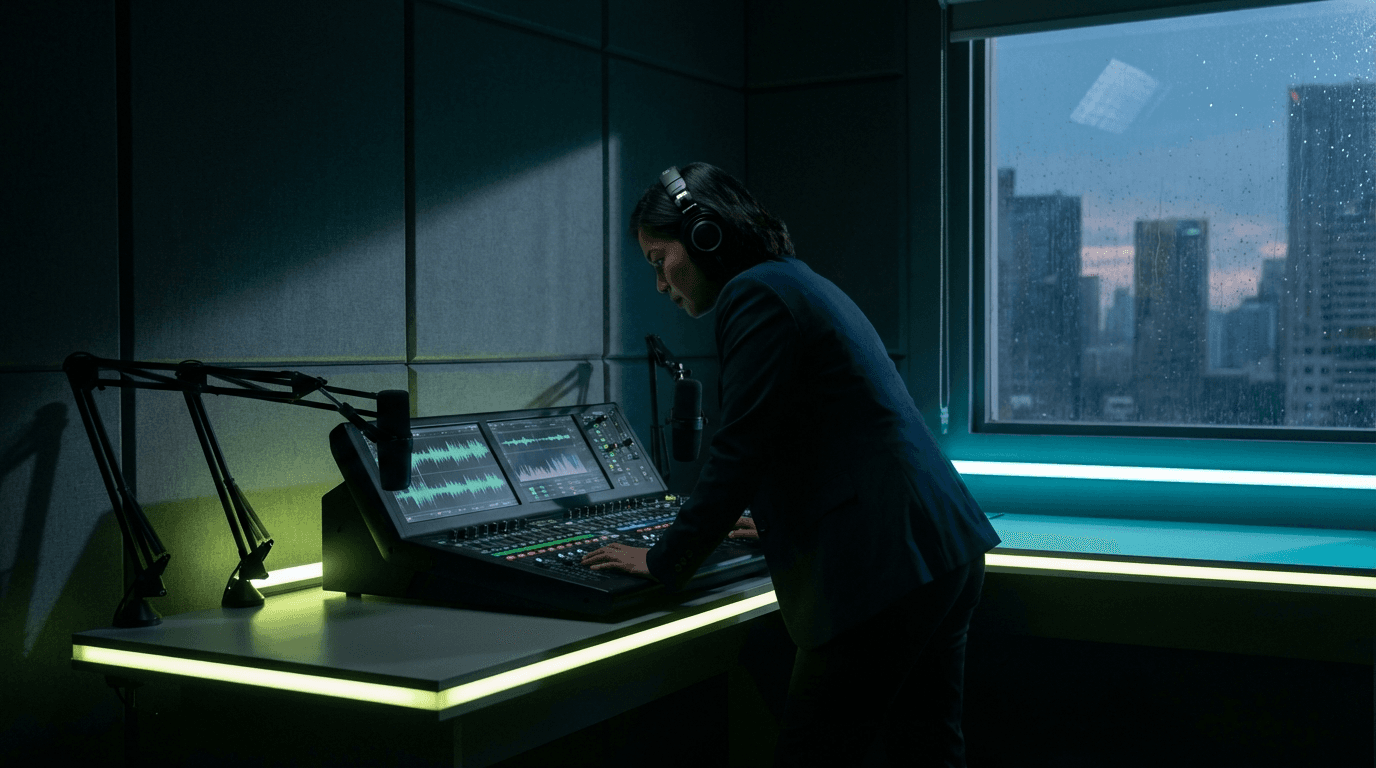

Podcast Production Outsourcing
4+ million podcasts exist as of 2026. Most of them sound like they were recorded in a bathroom and edited on a phone. The ones that don't? Someone else is doing the work. Since 2019, we've placed Filipino audio producers, editors, and show managers into Australian, UK, and US podcasts—and the pattern is always the same. The host has ideas and an audience. They don't have time to record, edit, master, and ship episodes while running a business. That's where outsourcing isn't a luxury—it's the only move that makes sense.
What is Podcast Production Outsourcing?
You hire someone to handle the bits you're not good at or don't have time for. Recording, editing, mixing, mastering, uploading, sometimes show notes or transcripts. You sit down, talk into a mic, ship the audio file to your producer, and 48 hours later it's live on Spotify, Apple Podcasts, and your website. They own the technical side. You own the ideas and the mic.
Why It Actually Matters
- You stay in your lane: If you're building a product, running sales, or doing the thing that makes money—keep doing that. Don't spend Tuesday nights trying to figure out Adobe Audition.
- Audio quality jumps immediately: A producer with proper gear, mixing knowledge, and 50+ episodes under their belt will make your show sound professional. That matters. Listeners notice. They stick around when it doesn't sound like a phone call.
- It's cheaper than hiring someone in-house: A full-time audio engineer in Australia or the US runs $60–100k/year plus super, training, and the fact they'll only be busy 2–3 hours a day on your podcast. A Filipino producer handling 2–4 shows per month? $1,500–3,000/month, flat. You scale up or down based on episodes.
- Consistency actually happens: When someone's accountable for the output, episodes ship on schedule. No dead air. No "I'll edit it next week and then forget for three weeks."
The podcast market is forecast at $1.6B+ by 2026. That growth is driven by quality. Shitty audio doesn't build audiences.
What Gets Handed Off
When you bring a producer in, here's what they typically own:
- Planning: Episode outline, guest coordination, recording schedule.
- Recording: Managing the tech (Riverside.fm, Zencastr, whatever), capturing clean audio, backing it up.
- Editing: Cutting dead air, bad takes, tangents. Levelling audio so the host and guest are at the same volume. Adding intro/outro music, sponsor reads, transitions.
- Mastering: Final pass to make sure the episode meets platform specs (loudness, metadata, file format). It ships clean.
- Publishing: Uploading to Spotify, Apple, YouTube, your website. Writing the episode title, description, timestamps. Scheduling social posts.
- Sometimes marketing: If you're part of a bigger show, they might manage clips for TikTok/Instagram, quote graphics, email newsletters. Depends on the deal.
How to Actually Hire
A lot of people mess this up. They post a job, hire the first person who says "yeah, I can edit podcasts," and get burned because the person's never used a DAW in their life. Here's how not to do that:
- Be specific about what you need: Do you want recording help, editing only, or full production? Are you doing one episode a month or four? What's your upload deadline? What's the show format (interviews, solo, co-hosted)? This stuff matters.
- Check their portfolio: Ask for links to three shows they've worked on. Listen to them. If they sound amateur or inconsistent, keep looking.
- Ask about their setup: What DAW do they use (Audacity, Adobe Audition, Reaper)? What gear? Do they have backup power and internet? In the Philippines, power can be dodgy—brownouts happen. A pro will have a backup plan.
- Talk to someone they've worked with: Previous clients will tell you the truth. Do they ship on time? Do they take feedback? Are they responsive? That's 80% of the hire.
- Do a test episode: Hire them for one episode before signing a contract. See if it works. If it does, commit to 3–6 episodes. If it doesn't, move on.
- Agree on process upfront: When do you send files? What format? When's the deadline? What if you miss the deadline? What happens if the audio is corrupted? Write it down.
What It Actually Costs
Price depends on what you're buying:
- Editing only: $200–600 per episode, usually $50–150 per hour. You do the recording, they clean it up and publish.
- Full production: $500–2,000 per episode. They handle recording, editing, mastering, uploading, show notes, transcripts. It varies by episode length, number of guests, and how much post-work you want.
- Monthly retainer: Some producers will do 4 episodes a month for $1,500–3,000. That locks in pricing and guarantees availability.
- Hidden costs: Music licensing (Epidemic Sound, Artlist—~$10–20/month), transcription if you want it ($50–200 per episode), social media clips if that's part of the deal. Factor it in.
Podcasts with professional production, consistent scheduling, and guest diversity have an 80%+ listener retention rate. Badly produced podcasts with random upload dates? 20–30%.
Why Filipino Producers Work
We've been hiring offshore since 2012 at REMAX. Podcast production is a newer skill set, but the pattern holds: Filipino talent is cheap, reliable, and good at audio work. Here's why:
- English is native: They can understand slang, accents, context. The Philippines is English-speaking enough that communication is straightforward. No translation breakdowns.
- They're creative and problem-solvers: Philippines culture is adaptive. When something breaks, they figure it out instead of waiting for instructions. You get proactive, not reactive.
- Cost is 60–70% lower than Australia or the US: A Filipino producer with 5 years of experience costs $1,500–2,500/month for 4 episodes. Same person in Sydney or LA? $5,000–7,000/month, minimum. That's not negotiable—it's the market.
- Timezone is workable: The Philippines is 2–4 hours behind Eastern Australia. You sleep, they edit. Wake up to a finished episode. Timezone lag is actually an asset for podcast production.
- Proven agencies exist: ShoreAgents, based in Clark, has placed 50+ podcast producers since 2019. They vet people, handle contracts, and manage handoffs so you're not coordinating directly with someone overseas. Cheaper than hiring locally, better than rolling the dice on Upwork.
Closing
Podcast production outsourcing isn't a shortcut. It's a business decision. Your time is the constraint, not money. If you're doing the show and the production, you're working 60-hour weeks and the show suffers anyway. If you hire a producer, you show up with good ideas, let them handle the rest, and actually build an audience.
Podcasting is 4 million+ creators competing for ears. The ones winning have production quality that doesn't distract from the content. Outsourcing to someone who knows what they're doing gets you there faster and cheaper than learning it yourself.
If you're ready to move your podcast from "I recorded this on my laptop" to "this is actually professional," we can connect you with Filipino producers who've done this 50+ times. Check out our get-started page or browse pricing to see what a few hours a month looks like for your show.
Ready to Outsource Your creative?
Build your offshore creative team with ShoreAgents. Zero-trust tracking, transparent pricing.
Related Articles
Video Editing Outsourcing
Footage backlog? Hire video editors in Philippines at $15–25/hr. Polished videos in 48–72 hours. Save $60k vs Aussie full-time hire. No licensing or payroll.
Graphic Design Outsourcing: Professional Designers From $735/mo
Design jobs are down 40%. AI ate entry-level work. Most businesses still outsource wrong. Here's when it actually makes sense—and when it absolutely doesn't.